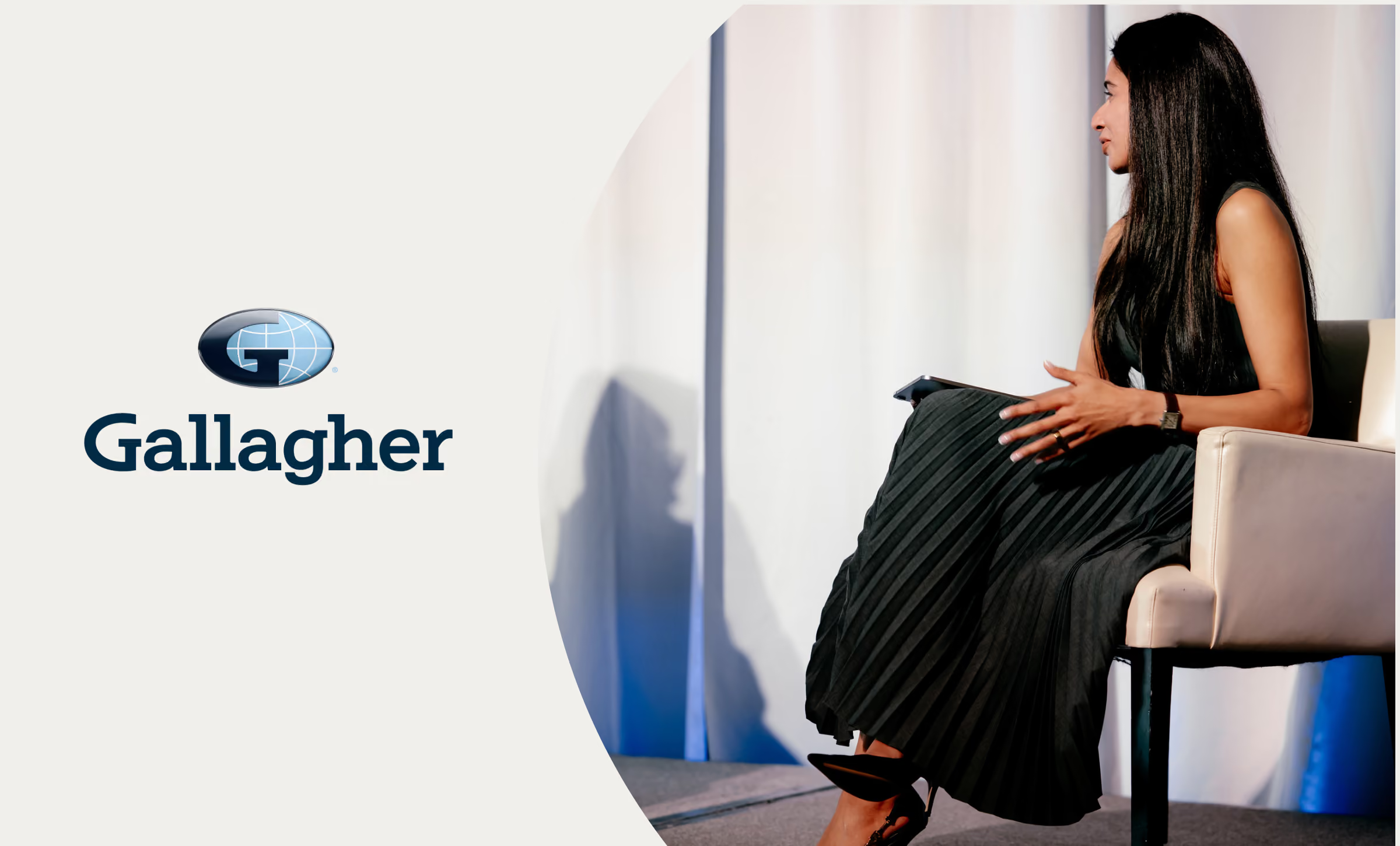
At Gallagher’s Global People Strategy Forum in Dublin, Carrot’s Chief Medical Officer, Dr. Asima Ahmad, joined Helena Brady, Head of Global Benefits at X Corp, for a fireside chat about one of the most urgent questions in benefits today: as AI becomes more visible across healthcare and benefits, what should employers expect from it, and what should they still insist on from human-led care?
For senior HR, people, benefits, and reward leaders, the answer is to build a benefits strategy that’s clinically sound, locally relevant, and designed around employees’ real lives. AI may have a growing role to play, but strong global benefits design still depends on thoughtful governance and a lifecycle approach that reduces complexity rather than adding to it.
Global does not mean one-size-fits-all
One of the clearest themes from the conversation was that offering a benefit globally is not the same as building one that truly works globally.
As Helena shared, global parity at X Corp was non-negotiable. Parity for her team means all employees can access care that feels fair, relevant, and usable in their local context. That looks like local language support, local provider networks, local regulatory understanding, and funding models that reflect real costs on the ground.
Helena also noted that fertility preservation has been one of the most-used parts of X Corp's family-building benefit, particularly among employees prioritizing career growth while keeping their options open for later. When employees plan for the lives they want to build instead of fixing something that’s broken, it tells you the support is landing in the right places.
This is where employers should expect more from their partners. In reproductive, family-building, and hormonal health, reimbursement alone is rarely enough. Employees need support navigating care pathways, especially in more complex cross-border situations. For example, surrogacy is illegal or restricted across many European markets, and clinic standards vary widely between jurisdictions. The right partner should help employers manage that complexity, not push it back onto employees.
That principle is core to Carrot's employer positioning. Global support must still feel locally relevant. For employers building international programs, the question is no longer whether a vendor can claim global reach, but whether they can convert that reach into safe, equitable care in practice. Aon's 2025 Employee Sentiment Study found that 72% of employees worldwide consider benefit customization important or extremely important and that customization has to mean something operationally not just on a slide deck.
Employees do not experience their health in silos
Another strong takeaway from the discussion was the need to move away from fragmented, point-solution-heavy benefits design.
Employees experience fertility, pregnancy, parenting, and menopause across a unified lifecycle. Yet many employers still offer separate solutions for each stage, creating a fragmented experience that can be difficult to communicate and even harder to use.
When benefits are too fragmented, employees have to figure out where to go and what applies to them. They’re left piecing together different programs on their own. For employers, that can make communications harder, reduce utilization, and weaken the overall perception of support.
The fragmentation problem shows up in the data too. PeopleKeep’s 2024 Employee Benefits survey found that only 47% of U.S. employees feel their benefits fit their specific needs, and nearly two-thirds say there are gaps in their benefits packages.
Menopause is a good example. Carrot’s 2025 Menopause in the Workplace survey, conducted with Ipsos across 3,000 U.S. women aged 35–54, found that 45% of employed women experiencing menopause symptoms report at least some impact on their work performance, and nearly one in four have considered reducing their hours as a result. Yet 64% say their workplaces offer no formal menopause benefits through HR at all. Menopause is still too often treated as a standalone add-on, rather than part of an integrated women's health offering alongside fertility and family-building support.
Carrot’s view, reflected in both the discussion and its employer-facing materials, is that lifecycle-led support is more effective than stacking point solutions. Fertility preservation, family-building, postpartum support, and menopause care are connected moments in employees’ lives, and benefits should reflect that reality.
This thinking also aligns with broader market signals. Carrot’s thought-leadership content has increasingly pointed to a need to move beyond narrow fertility-only framing and towards support that reflects what employees actually want across different life stages. For employers, that means building programs that are easier to understand, easier to access, and more likely to drive sustained value.
AI matters, but accountability matters more
AI was the headline topic of the session, but the conversation moved quickly beyond hype to accountability.
For benefits leaders, AI in health-related benefits raises a different level of scrutiny than AI in many other enterprise tools. The data is highly sensitive, the decisions can affect medical journeys, and the consequences of poor governance are much higher. Microsoft's 2026 Data Security Index found that only 47% of organizations across industries have implemented specific security controls for generative AI, meaning more than half are using the technology without governance designed for it.
But employers should go further when considering vendors claiming AI capability or AI-enabled technology. They should ask what the AI is actually doing, where human oversight sits, and whether the technology improves care or simply automates interactions that still require empathy and judgement.
One of the most valuable applications discussed was preventative care. Used well, AI can help identify risks earlier, prompt proactive outreach, and connect employees with support before issues escalate. That can improve employee experience, reduce avoidable complications, and strengthen cost management.
Still, the line was clear throughout the discussion: AI should support care, not replace it. In sensitive health moments, human judgement is irreplaceable. The right model is AI where it makes sense, and human support where it counts.
What employers should be asking vendors now
If there was one practical takeaway for benefits leaders, it was this: the vendor evaluation bar needs to rise.
Helena flagged one surprise in particular. She hadn't expected a benefits vendor to take on billing transparency and fraud detection across global care delivery, but it's become one of the most valued capabilities. It's a useful reminder that the most important vendor questions are sometimes the ones nobody is asking yet.
Beyond AI claims, employers should be asking:
- How do you ensure local relevance across markets, not just nominal coverage?
- How do you manage compliance and care quality in cross-border scenarios?
- How do you reduce fragmentation across fertility, family-building, and menopause support?
- How do you handle billing transparency and fraud detection across global care delivery?
- How does your technology improve prevention, transparency, or risk reduction?
- Where does human support remain central to the experience?
These are no longer edge-case questions. They are becoming core to responsible global benefits governance.
The future of global benefits is connected, preventative, and human-led
The strongest global benefits programs will be defined by whether they help employees access the right care, in the right context, with the right level of support.
That’s why the conversation between Carrot and X Corp resonated. It reframed AI as one part of a much bigger picture, that of a global benefits strategy built on local intelligence, preventative care, and lifecycle-led design.
For employers, that’s the real opportunity ahead: To build benefits programs that are more joined-up, more accountable, and more responsive to what employees truly need.