
34% of US employers offer paid paternity leave, and the competitive threshold sits at 8 to 12 fully paid weeks for non-birthing parents. While parental leave has been linked to improved outcomes for businesses and individuals, fathers are still offered less leave time overall, and most take under two weeks of what they are offered.
But building the leave package is only part of the job. With paternity leave, employers face two major issues: creating the policies and getting employees to use their leave time. The policies that work best take into account leave parity, manager training, leadership modeling, and competitive offerings.
Key takeaways
- In the U.S., there is no requirement to give paid paternity leave to employees. Eligible employees are entitled to up to 12 weeks of unpaid leave through the Family and Medical Leave Act, which can be used after the birth, adoption, or foster placement of a child.
- Paternity leave is a valuable benefit for non-birthing parents and their employers. The right leave offering can help keep operations running smoothly and attracts and retains top talent.
- While some companies may still use the term “paternity leave,” it is much more inclusive to use the gender-neutral “parental leave” when creating a new policy.
What counts as paternity leave in 2026
Paternity leave is paid or unpaid leave for non-birthing parents who work. It falls under the umbrella of parental leave, along with maternity leave. In most modern policies, leave for non-birthing parents is no longer called “paternity leave” because the term is not inclusive. Paternity leave is often referred to as parental leave in company policies, with different benefits offered for non-birthing/secondary caregiver leave.
The gender-neutral framing matters here because family structures are as diverse as workforces. Calling it “parental leave” makes space for adoptive, same-sex, and surrogacy families. This language also signals to employees that their employers will support their parenting and return-to-work journeys.
While there is no standard requirement for parental leave in the United States, many states have passed laws that mandate parental leave for eligible workers. The Family and Medical Leave Act (FMLA) entitles eligible employees to 12 weeks of unpaid, job-protected leave for certain family and medical reasons, including care for a newborn child within one year of birth, and placement of an adopted or foster care child with an employee. This is the baseline every company should keep in mind when creating their leave policies. However, providing a more generous paid parental leave program has been proven to benefit both employers and employees.
Why paternity leave matters
Previously, paternity leave may have been seen as a “perk” for employees. Now, it’s not just seen as a nice-to-have, but a lever companies can use to attract and retain talent, and improve employee satisfaction and loyalty. So why does paternity leave matter for everyone?
- Improves morale and lowers turnover. A survey of employers in California found that 93% of employers said paid family leave had a positive effect on employee turnover, while 97% said there was a positive impact on morale.
- Increases engagement and motivation. Supporting the family-building journeys of employees can make those employees feel more valued, which leads to better performance and productivity.
- Better job satisfaction and employee wellbeing. 69% of fathers have stated that they would switch jobs to spend more time with their families, while 40% said they would have taken longer leave if they’d received more pay.
- Can lower operational costs. Replacing top performers is expensive — ranging from 50-200% of that employee’s salary to find, hire and train someone new.
- Creates more equitable workplaces. Paid parental leave for all employees, regardless of gender, recognizes a broader spectrum of how people build their families and care for children.
Not to mention, paid parental leave (which includes leave for fathers) has been shown to positively impact productivity and performance. These findings demonstrate how a work environment that supports family-building journeys benefits both individuals and companies. Or, in other words, paid leave policies are better for working parents and better for a business’s bottom line.
Yet a 2023 report from the Department of Labor found that only 27% of workers had access to paid family leave. A survey of Fortune 500 companies found that 75% offer some paid leave — but typically offer more leave to birthing parents than non-birthing parents. This raises questions about how businesses can offer more holistic support for all parent workers, using a combination of parental leave and other comprehensive benefits.
What top employers actually offer
Considering the benefits of providing employees with paid parental leave, how much leave are top companies actually providing? According to the U.S. Bureau of Labor Statistics, 27% of private industry workers have access to paid family leave as of 2023. This means that 73% do not have any paid leave available to them. Paid parental leave averages about 12 weeks for birthing parents and just 6 weeks for non-birthing parents. These numbers paint a clear picture: many employees are not getting the support they need to bond with and care for their families.
Studies have proven that offering paid parental leave is a competitive advantage in the recruitment and retention of skilled talent. Employers with the best benefits will often attract the top talent. What does that look like? The competitive threshold in 2026 is 8 to 12 fully paid weeks for non-birthing parents, while 16 weeks or more would be considered best-in-class.
“Competitive” leave benefits can also vary by industry. While the tech industry might be known for offering more generous parental leave, other industries, such as retail, typically offer below the competitive range.
Average parental leave allotment by industry
Source: Bnchmrk
How to structure a competitive policy
Paid parental leave policies are defined by seven key elements, but most employers only consider three of them deliberately.
- Duration of leave. How many weeks of paternity leave are guaranteed, and how can that leave be used? Consider any legally mandated minimum leave periods, as well as industry standards and overall company strategic goals.
- Pay and funding source. If you’re offering paid leave, explain how employees who use the benefit should expect to be paid. Will they receive pay through the employer? Short-term disability plans, insurance, or state-sponsored paid leave? What percentage of their usual pay will they receive?
- Eligibility requirements. Define what criteria must be met for an employee to receive benefits. Include specifications around full- and part-time employees, as well as length of service at the company.
- Flexibility. Can the leave be used at any time? Does it have to be used consecutively, or can it be broken up into shorter periods? Is it only good for the 12-month window after a child has joined their family through birth, adoption, or foster care?
- Job protection and return-to-work guarantee. Provide reassurance that those who take paternity leave will return to the same (or equivalent) position.
- Coordination with state programs. Explain how paid parental leave works with existing state programs, and provide additional resources.
- Parity across adoption, surrogacy, and foster placement. How does the company support adoptive parents, parents welcoming a child through surrogacy, or non-birthing parents, regardless of gender?
Getting fathers to actually take parental leave
Even when employees are given parental leave, they may only take some of what they are allotted, or none at all. This can be true for some of the most generous policies. To get all of the strategic business benefits of paternity leave, it makes sense to encourage them to take the leave that’s available to them.
However, three common barriers prevent employees from using paternity leave:
- Financial - If leave is unpaid or paid at a percentage of typical wages, it may not be financially viable for the employee to take the full leave allotment.
- Fear of career penalties - Some employees may feel that their career will be negatively impacted if they use parental leave.
- Managers - Managers and supervisors might imply that it’s not okay to take leave, even when it’s part of the company’s formal policy.
According to SHRM, 72% of men say they would have taken a longer paternity leave if they had witnessed coworkers doing so. This points to the issue of using paid paternity leave as largely a cultural one. So how can you encourage fathers to take paternity leave when they are feeling external pressures not to? Here’s what works:
- Ensure that leadership has set the precedent by taking paternity leave, sharing their experiences, and modeling how the company would like employees to act.
- Use a neutral name (such as “parental leave” rather than “paternity leave”) that makes it clear anyone is entitled to use their leave.
- Train managers on how to approach conversations about leave with employees so that they are not inadvertently discouraging them from taking time off.
- Create clear processes that explain how coverage will work when employees are away, how they can properly prepare for leave, and what they can expect when returning to work.
It can also be useful to track usage rates to benchmark how often leave is taken so you can make data-informed decisions moving forward. By normalizing usage of paternity leave and protecting employees’ legal rights to parental leave, companies can foster an environment where parental leave for fathers is actively used.
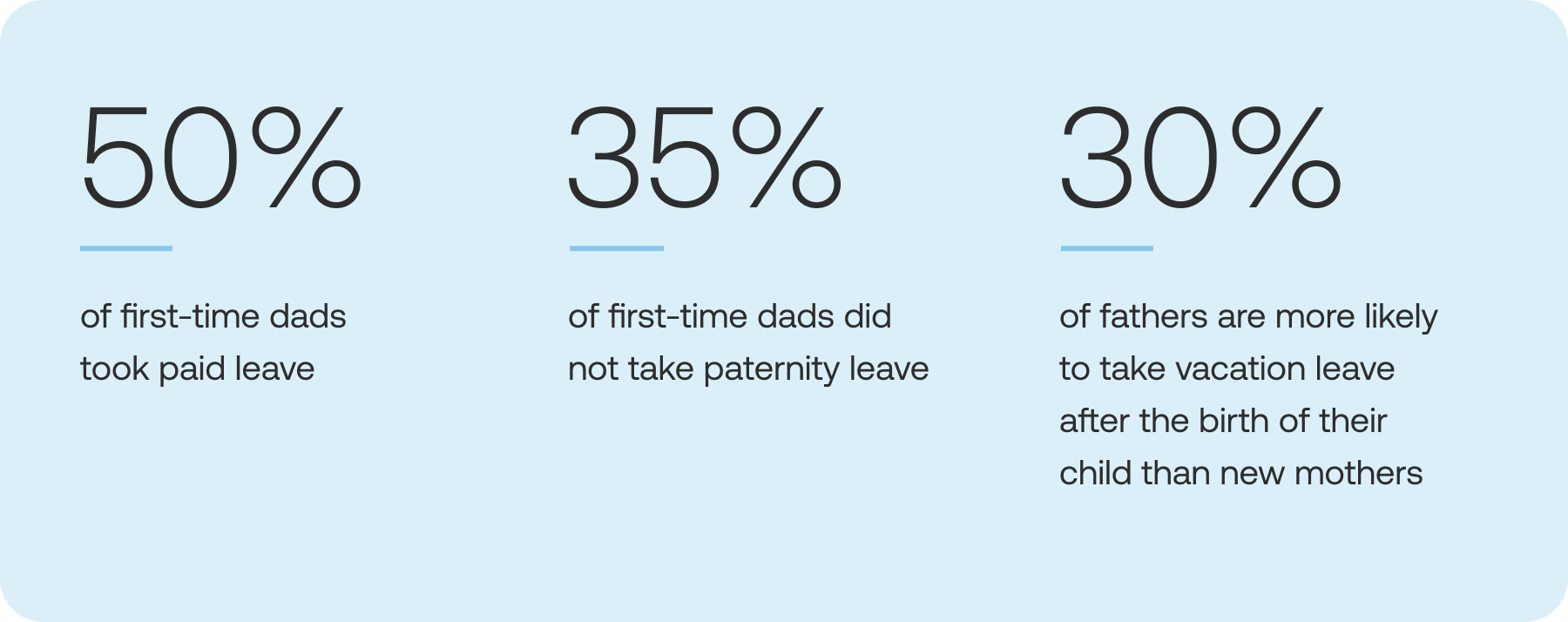
Source: U.S. Census Bureau, 2022 Survey of Income and Program Participation
FAQs
Is paternity leave required by law in the United States?
No, paternity leave is not required by law in the United States. Eligible workers are entitled to take up to 12 weeks of protected leave for the birth of a child and bonding, but this leave is unpaid. For this reason, many cannot afford to forgo their regular paychecks to take the full leave amount.
How many weeks of paternity leave should we offer?
The number of weeks offered depends on the industry. Research what similar companies are offering to get an idea for what is normal and what would be competitive. Consider using gender-neutral language (e.g. parental leave) and allowing the same benefits for birthing and non-birthing parents.
What does a paid paternity leave policy cost?
The cost of paid paternity leave varies, and may be impacted by state laws. You will have to do your own research into this. However, it’s important to note the costs of not offering paid leave: lower employee engagement, poor employee morale, and high turnover rates.
Should our policy say “paternity leave” or “parental leave”?
“Parental leave” is a more inclusive, neutral framing for your policy. Workforces are diverse, and so is the way employees approach family-building. To provide the best possible experience for employees, opt for “parental leave”.
Providing parental leave for every employee
What goes into a “good” paternity leave policy? Certainly the details about how much time an employee is allotted, and how they can use that time. But parental leave is only a single touchpoint in an individual’s family-building journey. There is so much more that can’t be covered by a simple policy. Employers can nurture satisfied, engaged employees by prioritizing not just parental leave, but day-to-day support through every step of the journey. Request a demo to learn how you can provide employees with personalized, expert-guided care.