The fertility industry has an AI credibility problem. Dozens of companies now claim AI capabilities, but few can point to clinical evidence that their technology changes health outcomes. Last week, Carrot brought that evidence to a national stage.
Carrot, the leading global fertility and family care platform, presented accepted research at the inaugural U.S. Department of Health and Human Services (HHS) National Conference on Women's Health. The findings represent the first clinical evidence for an AI-driven approach to preconception metabolic optimization.
The stakes are high: only 12.2% of U.S. adults meet criteria for optimal metabolic health. For women and men of reproductive age, poor metabolic health is a leading — and routinely overlooked — driver of infertility, failed fertility treatments, and pregnancy complications. Yet no clinical standard exists for addressing it before conception begins.
The Premester: A missing chapter in reproductive medicine
The three trimesters of pregnancy are universally recognized. The months before pregnancy are not — despite growing evidence that metabolic health during this window shapes everything from fertility treatment success to long-term maternal and child outcomes.
The research, presented by Dr. Asima Ahmad, Carrot's Chief Medical Officer, proposes the "Premester" — the 3–12 months before pregnancy — as a distinct, high-impact clinical window for metabolic-fertility intervention. "Historically, it's after people are already struggling to conceive or experience a poor health outcome that their metabolic health is evaluated or addressed," said Dr. Ahmad. "The Premester changes that. Our data suggests that earlier, AI-personalized intervention during this window can improve fertility and pregnancy outcomes."
Dr. Ahmad expanded on this perspective as a featured speaker at the HHS conference during a discussion titled, "Addressing Chronic Conditions in the Evaluation of Infertility," highlighting the critical role of diagnosing and addressing underlying metabolic and chronic conditions — such as PCOS, endometriosis, and insulin resistance — earlier in the infertility journey — shifting care from reactive treatment to earlier, more targeted intervention.
Sprints: Closing the gap between metabolic health and fertility
Metabolic health is one of the most significant — and most addressable — drivers of infertility and pregnancy complications. Yet no existing fertility program has used AI to target it systematically before conception. Sprints was built to fill that gap.
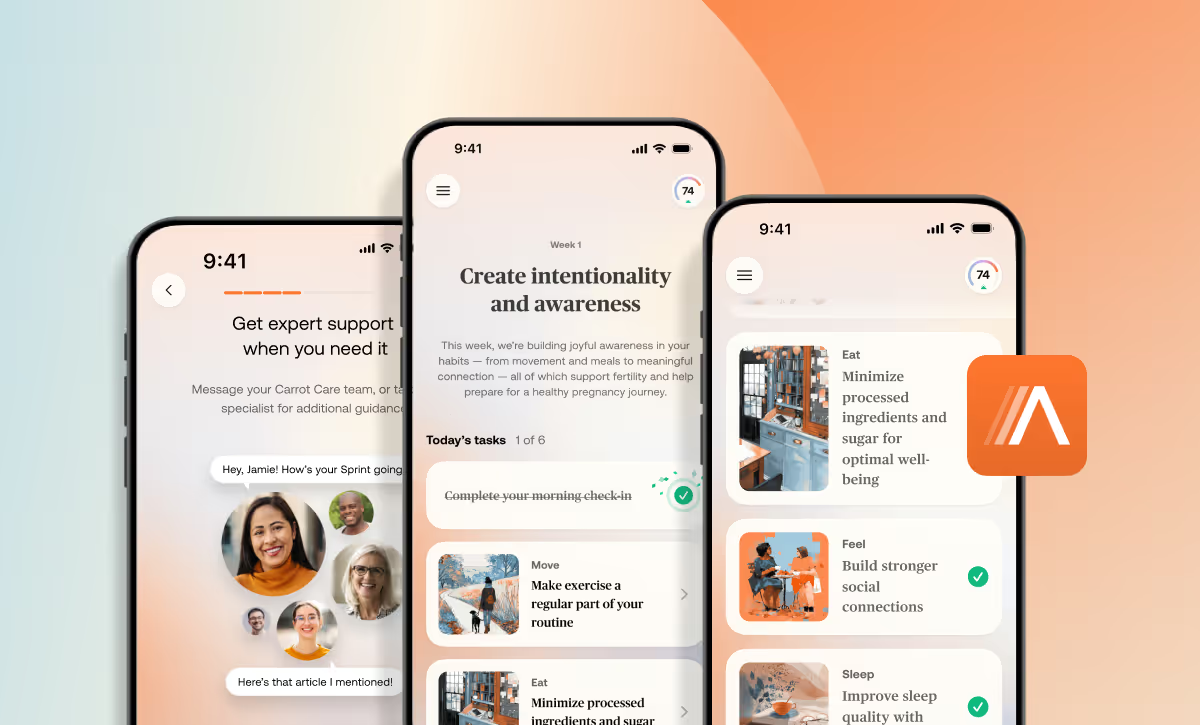
Launched in Fall 2025 and already serving members across Carrot's enterprise client base, Sprints is the first metabolic-fertility program to combine clinical expertise, continuous wearable biometrics, and generative AI into a single daily experience for people trying to conceive.
What makes Sprints structurally different from other AI health tools is where the AI sits in the process. The program operates on two distinct layers of hyper-personalization:
What to do — driven by clinical science. Carrot's clinical team determines the daily actions each member should take across four metabolic pillars — nutrition, movement, sleep, and stress management — drawing on evidence-based protocols, the member's fertility goals, and each member's current metabolic health profile. The AI does not make clinical decisions. The care plan is set by clinicians using established science.
How to deliver it — driven by Generative AI. Carrot's proprietary GenAI engine takes those clinically determined actions and translates them into the message, tone, timing, cadence, and imagery most likely to motivate each individual member to follow through. The system builds what Carrot calls a "motivational phenotype" — a continuously refined model of what makes each person most likely to adopt and sustain healthy behaviors.
"The program feels realistic. I'm really motivated and it's become part of my routine to do each day. I really look forward to it!" - Carrot Sprints member
One member may respond to morning nudges with data visualizations; another to evening check-ins with encouragement. The result is a system that doesn't just know what you need — it knows how to get you there. This separation is deliberate. In most AI health products, the algorithm decides what users should do. In Sprints, clinicians decide the what; AI optimizes the how. The result is a system where hyper-personalization drives adherence without compromising clinical rigor.
The Carrot platform, including Sprints, is increasingly powered by three integrated capabilities:
Continuous biometric intelligence. Sprints integrates data from wearable biosensors — sleep quality, HRV, activity, stress, skin temperature, period tracking, and fertility indicators — to build a continuous metabolic health picture rather than relying on periodic snapshots. Members receive analysis of cycle patterns, sleep trends, activity, and glucose levels, giving them and their care teams a holistic view of metabolic-fertility health.
A Generative AI engine that learns daily. The GenAI engine generates individualized daily actions and recalibrates continuously through daily check-ins and member feedback — refining both the metabolic guidance and the motivational approach over time.
Clinical expertise in the loop. Carrot's clinical teams interpret wearable data within the context of each person's fertility and metabolic profile, driving hyper-personalized care planning and ongoing progress assessments. This human-AI partnership ensures recommendations remain clinically sound, personally relevant, and continuously refined.